EuroQCI – Quantum network covering the EU
Quantum-Safe software-defined Deterministic Networks, including a Deterministic Industrial Internet of Things (D-IIoT) network and a Deterministic Data-Center network (D-DCN), can support ultra-secure communications for the 21-st century. According to the World Economic Forum (WEF), the world is in the midst of the 4th Industrial Revolution called Industry 4.0. This revolution will integrate the IoT (Internet of Things), AI (Artificial Intelligence), and Robotics to streamline industrial manufacturing, and will under-pin future global economic growth. The D-IIoT/D-DCM will enable the ultra-low-latency and ultra-secure Machine-to-Machine (M2M) communications required to support Industry 4.0, AI and Data-Centers. To achieve exceptionally strong cyber-security they will integrate new technologies, such as the Zero Trust Architecture (ZTA), Post Quantum Cryptography (PQC), and Quantum Key Distribution (QKD). Applications will include Artificial Intelligence, Smart Cities, the Smart Power Grid, Smart Manufacturing, Smart Healthcare, Green Cloud Computing, and Industry 4.0. Articles summarizing these ideas have appeared in the IEEE Communications Magazine, the IEEE Access Magazine, the IEEE Transactions on Communications, and the IEEE Transactions on Networking.
The existing Internet is over 4 decades old, and is in a perpetual state of cybersecurity crisis. According to the US government, cybercrime costs the USA about 4% of its economic output every year. Globally, the costs of cybercrime are estimated to be between $1- $10 trillion (US) per year. According to the US National Academy of Engineering, achieving Security in Cyberspace is one of 14 Grand-Challenge problems in Engineering for the 21-st century. There may be some reluctance to introduce changes to the 4-decade old Internet, but the costs of inaction are high. According to the World Economic Forum’s report “Global Cybersecurity Outook 2025”, the level of complexity of cybersecurity challenges shows no sign of abating. They state “This is a call to action, and the time to act is now”. QSafe’s proposed D-IIoT/D-DCN can save $100s of billions (US) in capital costs every year, and they can eliminate the vast majority of cyberattacks, thus reducing the global costs of cybercrime by several trillion dollars (US) every year.
The world is currently spending tens of billions of dollars (US) to develop satellite-based Space-Ground QKD systems. China is developing global-scale ultra-secure satellite-based QKD systems, and it may deploy a global QKD service perhaps by 2030. The European Union is building its Quantum Communication Infrastructure in the EuroQCI project, and is planning to deploy an ultra-secure satellite-based QKD service by 2030 with 282 satellites. Despite their multi-billion dollar costs, these systems will not offer “Unconditional Security”. My latest paper in the IEEE CCNC conference in Las Vegas (Jan. 2026) describes a “Cyber-security Paradox for QKD”. It presents a Quantum Security Paradox which proves that satellite-based Space-Ground QKD systems with 1,000s of satellites are vulnerable to backdoors and global surveillance in practice, where millions of secret QKD keys may be exposed. Users of global QKD services will be vulnerable to undetectable surveillance by unknown third parties. Contrary to popular belief, satellite-based QKD systems are insecure. We show that a classical D-IIoT can help strengthen satellite-based QKD. It can even replace satellite-based QKD systems completely.
QSafe’s proposed D-IIoT can strengthen QKD by mitigating information leakage in the classical (non-quantum) network. It will eliminate Denial of Service (DoS) attacks, and most insider and outsider attacks. The D-IIoT switches can use 1,000 times less buffering than regular Internet routers, and they can therefore be built using FPGAs (Field Programmable Gate Arrays). They are small and energy-efficient and can fit into satellites, and they use Artificial Intelligence-based rules to detect and eliminate cyber-attackers. The D-IIoT was first proposed in a paper entitled “The Cyber Security via Determinism Paradigm for a Quantum-Safe Zero-Trust Deterministic Internet of Things”, available on the IEEE website (https://ieeexplore.ieee.org/document/9761236). An IEEE video of a real-time Quantum-Safe Zero-Trust D-IIoT network is also available at the IEEE web-site: (https://ieeexplore.ieee.org/document/9761236 ).
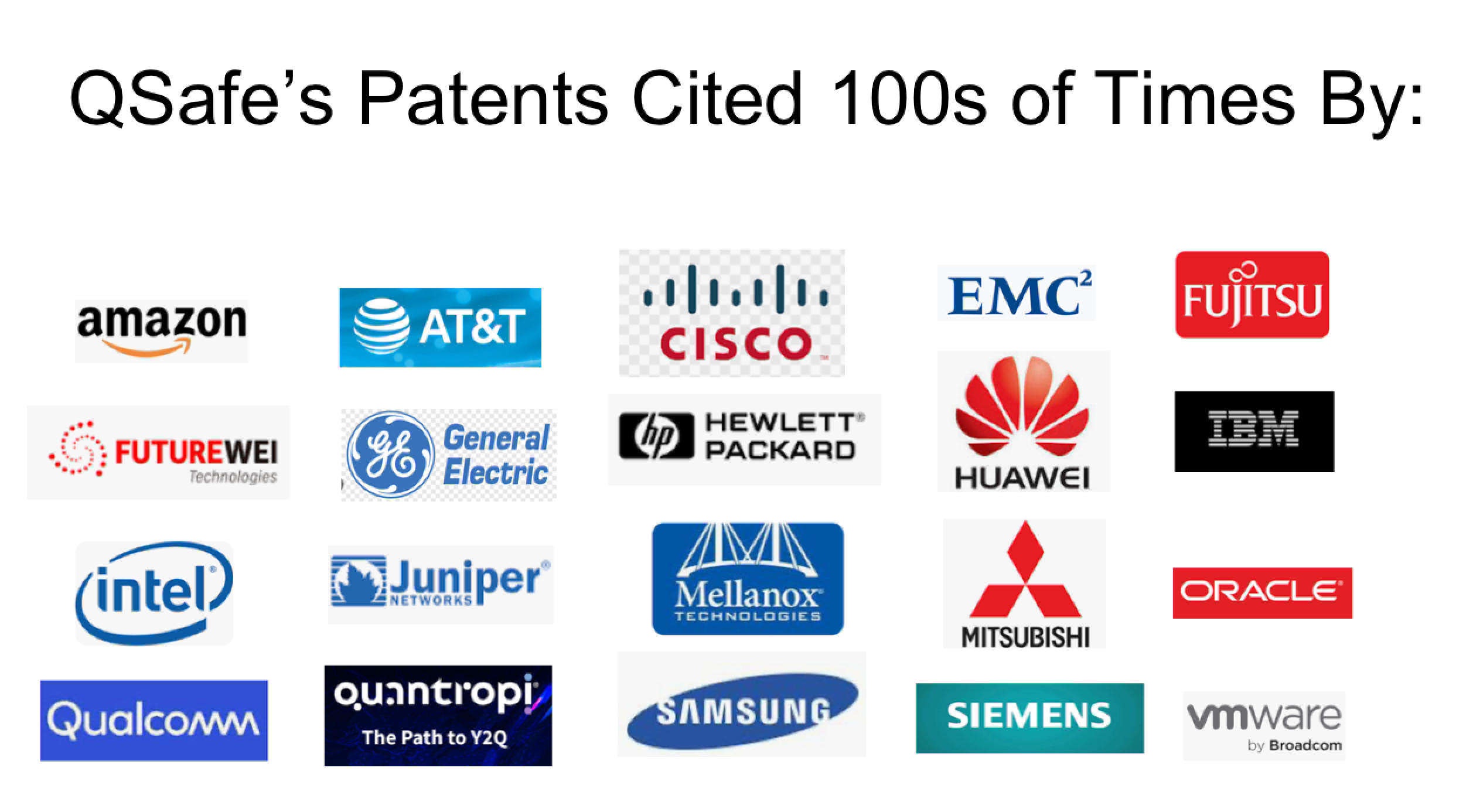
Ted is a Professor Emeritus in the Department of Electrical and Computer Engineering (Dept. ECE) at McMaster University in Canada. Ted has also been a professor at McGill University in Montreal, and Columbia University in New York. Ted holds 20+ US patents on a Deterministic Internet, SDN (Software Defined Networking) and Cyber-Security, which have been cited as prior art hundreds of times by most major telecommunications companies including: Amazon, AT&T, Cisco, EMC, Fujitsu, Futurewei, Huawei, Juniper Networks, General Electric, Hewlett Packard, IBM, Intel, Mellanox, Mitsubishi, Oracle, Samsung, Siemens, Qualcomm, Quantropi, VMware, and many Chinese, Japanese, Korean and world patents. Ted is listed in the top 2% of researchers worldwide in the field of networking and telecommunications, according to Stanford University and Elsevier Publishers.
A YouTube video entitled “A SPEED OF LIGHT INDUSTRIAL INTERNET OF THINGS” describes the D-IIoT. An energy-efficient real-time Deterministic Industrial Internet of Things network is explained. The real-time Industrial/Tactile Internet network will enable deterministic Machine-to-Machine (M2M) and Human-to-Machine (H2M) communications. Applications include Smart Cities, the Smart Power Grid, Smart Manufacturing, Smart Healthcare, Cloud Computing, Video Distribution and the next wave of the Industrial Revolution.